


Key Takeaways
- Poorly fitted glasses can lead to headaches, eye strain, and discomfort.
- Three numbers inside your frame arm tell you the lens width, bridge width, and temple length.
- Your pupils should sit centred in each lens, and your frames should clear both your brows and cheeks.
- Signs of a poor fit include sliding frames, pressure marks behind the ears, and tilting your head to see clearly.
- An optometrist or optician can measure your pupillary distance and adjust your frames for a comfortable fit.
The Fit That Makes or Breaks Your Glasses
You pick up your glasses in the morning, and soon they’re sliding halfway down your nose. By afternoon, there’s a dull ache behind your ears. Sound familiar? A lot of people assume that this is just part of wearing glasses. But it doesn’t have to be.
Glasses that fit properly sit comfortably on your face all day, keep your vision clear without tilting or causing you to squint, and don’t cause pressure points where they touch your skin. If you’re due for updated lenses, our team at Lowy and Sewell Eye Care can pair a proper fitting with a comprehensive eye exam to make sure that both your lenses and your frames support clear, comfortable vision.
Key Frame Measurements & What They Mean
The 3 Numbers on Your Frame
Flip open one of your temple arms and look inside. You’ll likely find a sequence of three numbers, something like 52-18-140. These represent your lens width, bridge width, and temple length, all measured in millimetres. Together, they tell you how a frame is sized.
If you’re shopping for a new pair, your current glasses are a great place to start. If your current frames fit you well, those numbers give you a reliable reference point for your next pair. A slight adjustment up or down on any one measurement can change the overall feel quite a bit. Our frames and lenses available cover a wide range of sizes and styles, so finding something that matches your measurements is usually straightforward.
Pupillary Distance and Why It Counts
Pupillary distance, or PD, is the measurement from the centre of one pupil to the other. It tells the lab where to place your prescription so that your eyes line up with the optical centre of your lenses when you look straight ahead.
When the PD measurement is off, even by a few millimetres, your vision can end up slightly strained or distorted. Prolonged strain from a misaligned PD can contribute to symptoms similar to digital eye strain, like headaches and tired eyes, especially after extended screen time.
How Glasses Should Fit Each Part of Your Face
Eyes, Brows, and Cheeks
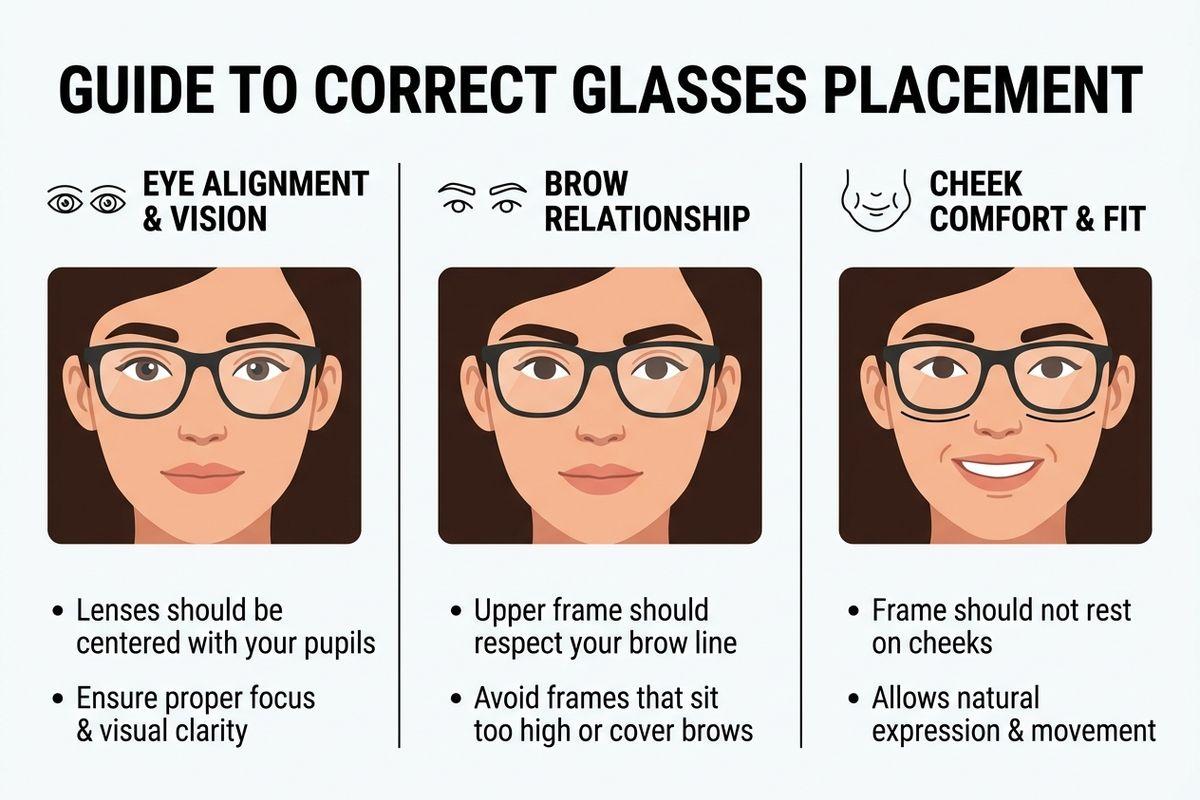
When you put your glasses on, your pupils should sit roughly centred in each lens, both horizontally and vertically. This keeps your prescription working the way it’s meant to.
Your frames should sit just below your eyebrows, not covering them. When the top of the frame cuts across your brow line, it can look unbalanced and often signals that the frame is too tall for your face. On the other side, the bottom of the frame should clear your cheeks completely. Frames that rest on your cheeks will shift every time you smile, which makes the fit inconsistent.
Nose, Ears, and Temples
The bridge of your glasses should rest on your nose without pinching or leaving red marks. It also shouldn’t be so loose that the frames slide forward when you look down.
The temple arms, the parts that extend back to your ears, should curve gently and rest lightly on top of your ears. You shouldn’t feel them digging in. A good test is to shake your head side to side. Your glasses should stay in place without you needing to push them back up.
Signs Your Glasses Don’t Fit Right
It’s easy to get used to a poor fit over time, but your body usually gives you signals that something is off. Watch for these signs:
- Frames sliding down your nose throughout the day.
- Temple arms leaving marks or digging in behind your ears.
- Your glasses are feeling crooked
- Tilting your head to the side to see clearly
Any one of these is worth addressing. If you ignore discomfort, it tends to compound, which can affect how often you reach for your glasses. Scratched or damaged lenses can add to that frustration, so knowing how to handle scratched lenses can help you decide when it’s time to replace them rather than push through.
How to Find Glasses That Fit Your Face Shape
Common Face Shapes and Frame Styles
Most face shapes fall into four general categories: oval, round, square, and triangle. Oval faces tend to suit a wide range of frames. Rounder faces often look balanced with frames that have more angular lines. Square faces can be softened by rounded or oval-shaped frames. Triangular faces, which are wider at the jaw or forehead, often benefit from frames that draw attention upward or downward to balance proportions.
No matter your face shape, one rule holds across all of them. The width of your frames should align roughly with the widest part of your face at the temples. When your frames are noticeably wider or narrower than your face, their fit and look both suffer.
When to Get a Professional Adjustment
Persistent discomfort after wearing a new pair of glasses for a few days is a clear sign that you need an adjustment. Opticians can bend and reshape temple arms, adjust nose pads, and in some cases recommend a different frame shape or size altogether.
It’s also worth checking in periodically, even when things feel fine. Frames shift gradually over time, especially with daily use. Regular adjustments at Lowy and Sewell Eye Care can keep your glasses fitting comfortably and working the way they should. Our team, serving Vaughan and the surrounding area, is available to help you find frames that fit your face, your prescription, and your day-to-day life. Reach out to book a visit.